✓ You're in. This is your copy — bookmark it. It stays yours whether you ever buy anything or not.
The Pop-Up Playbook
How to be ready for a sale before it happens
For anyone who sells at markets, fairs, festivals, or out of a truck. None of it touches your product,
your prices, or how you run market day — that part is yours and it already works. Read it in twenty
minutes. Build it in ninety. It'll pay for itself the first Saturday you use it.
Start with your own number below — it decides how much of this is worth your time.
The whole playbook is on this page — nothing to download, nothing arriving in the post.
Your market day
Three honest guesses.
Nobody's checking. Move them until they look like your Saturday.
12
Sold out · doesn't ship · wrong size · cash only. Count them all.
$15
Not your best one. The ordinary one.
14
However many you actually trade.
Demand that showed up and left
$180
in a single market day
$2,520
across your season
Demand you already earned and couldn't serve — not a forecast, and not a promise of revenue.
What that number means
…
…
Nothing is sold on this page. Read the five parts, then there's a plain answer at the bottom
about what to actually do first.
This is the whole method, written out. You can build every part of it yourself and never pay me anything.
Where a piece already exists made-up and ready, I've said so and told you where it lives — but there's
nothing to buy on this page.
You sold out at 10:40. The demand didn't.
Selling out is a win. You made something people want, and enough of them found you to clear the table. That is the hard part, and you did it.
Here's the part the win hides. You ran out of the good stuff at 10:40. The market ran until two. For the next three hours and twenty minutes people kept arriving who wanted it, and the only thing there was to hand them was sorry, all gone — so they walked off with money in their pocket and nowhere to spend it.
Then Sunday came. Then Monday. Those people still wanted it on Tuesday — there was just no way for them to reach you, because everything you sell lives on one table for six hours a week.
That's the gap. Not a problem with the product and not a problem with your Saturday — a missing piece between the two.
This playbook builds that missing piece, and it doesn't ask you to make more product, get a bigger tent, or post more on Instagram. The recipe, the pricing and the table stay exactly as they are. It asks for about ninety minutes of setup, one time.
Selling at craft fairs, festivals, holiday markets, or out of a truck instead? Every single thing in here works the same. Swap "market" for whatever you do. The mechanics don't change.
The Sold-Out System
Five parts, in the order a market day actually happens. Do them in order. Part 1 carries the most weight, and it's the one that usually waits — because it's an evening job and in season there aren't spare evenings.
1
One Link
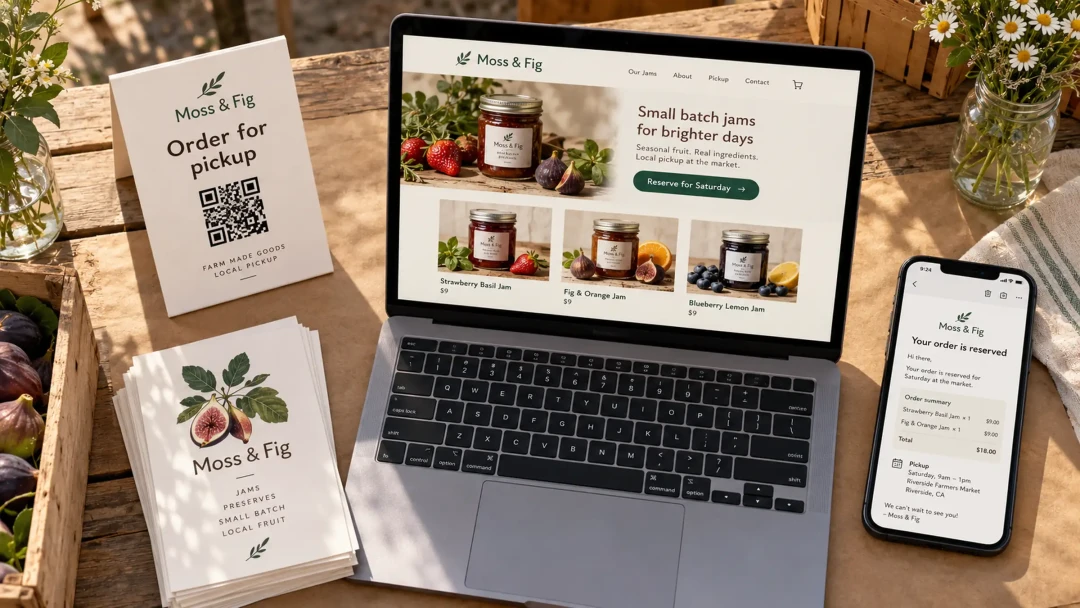
What it is: a single web address that holds everything you sell, including the things that aren't on your table today.
Not your Instagram. Not a Linktree of dead ends. One page, built to take money.
One page that holds everything you sell, including the things you ran out of.
What's missing without it: right now, when someone wants what you don't have, the only things you have to offer are "come back next week" or a business card. Come-back-next-week works on almost nobody. The card goes in a pocket, through the wash, into the bin.
What goes on the page
This is the important part. A shop page with the same four things that were on the table only serves the people you could already serve. Your link should cover every version of yes a person might have:
The things you sell. Obviously.
Pre-order for next market. Reserve it now, pick it up Saturday, pay now or on pickup. This is how you convert a sell-out instead of losing it. It also tells you how much to make.
Shipping. Even if it's just a flat rate to your own state. "Do you ship?" is a yes you can't say yet.
The bigger version. Bulk, a case, a variety box, a subscription. Somebody at every market wants more than one and will never ask.
Gift cards. Zero inventory, paid today, redeemed later, and often for more than the value. From September on, this is your best-performing item and it costs you nothing to carry.
Wholesale and events. One line: interested in stocking this, or want it at your event? Tell me here. The café owner and the wedding planner walk past your table more often than you think. They will not email you cold.
Where to find you next. Your market schedule, kept current.
The rules that make it work
Short, sayable link. Something you can shout across a table and someone can type wrong and still land. yourname.com/market beats a random string of characters.
They buy without an account. No signup, no app, no "create a password." Every extra tap loses people.
It works on a phone, in the sun, on bad market wifi. Test it standing at your own table before you trust it.
Nothing on it is ever "sold out." If you can't ship it today, sell the pre-order. The link is the store that never runs out.
What to actually sign up for
Three that work for this, in the order I'd pick them for a market vendor. Prices move, so treat these as the shape of the bill rather than a quote.
Shopify — around $29–39 a month. The right answer for most people reading this. Pre-orders, shipping rates, gift cards and a card reader that shares the same customer list all exist out of the box. The most expensive of the three and the easiest to get selling on.
Squarespace Commerce — around $23–28 a month. Pick this if you want the site and the shop to be one thing and you care how it looks. Gift cards and shipping are fine. Pre-orders need a workaround, which matters here, because the pre-order is the whole point of Part 1.
WordPress and WooCommerce — the software is free, hosting is around $10–25 a month. Pick this if you already have a WordPress site or you want to own every piece of it. It costs you an evening or two more than the other two, and updates become your job.
Already take cards with Square at the table? Square Online is free and plugs straight into the reader you already own, so your in-person and online sales land in one customer list. It is weaker at pre-orders and gift cards than Shopify. For a lot of people it is still the fastest route from here to a working link — and working this Saturday beats perfect in March.
The platform decides where the page lives and who takes the card. It does not decide what goes on the page or in what order — that part is this playbook, and it is the difference between a shop page and a link that converts a sell-out.
Not sure which one fits? →Fifteen minutes, free. Tell me what you sell and I'll tell you which one I'd use.
Ten-minute version: one page, three things — pre-order for next market, a gift card, and a "notify me when it's back" box. That alone captures most of what you're losing.
If you'd rather not build it
This whole page already exists as a clonable funnel — seven blocks in the order that converts, plus the walkthrough from clone to live. It's the piece that waits, because wiring up a checkout is an evening job and in season there aren't spare evenings. It's in the room.
2
The Sign
What it is: how your table asks for the scan.
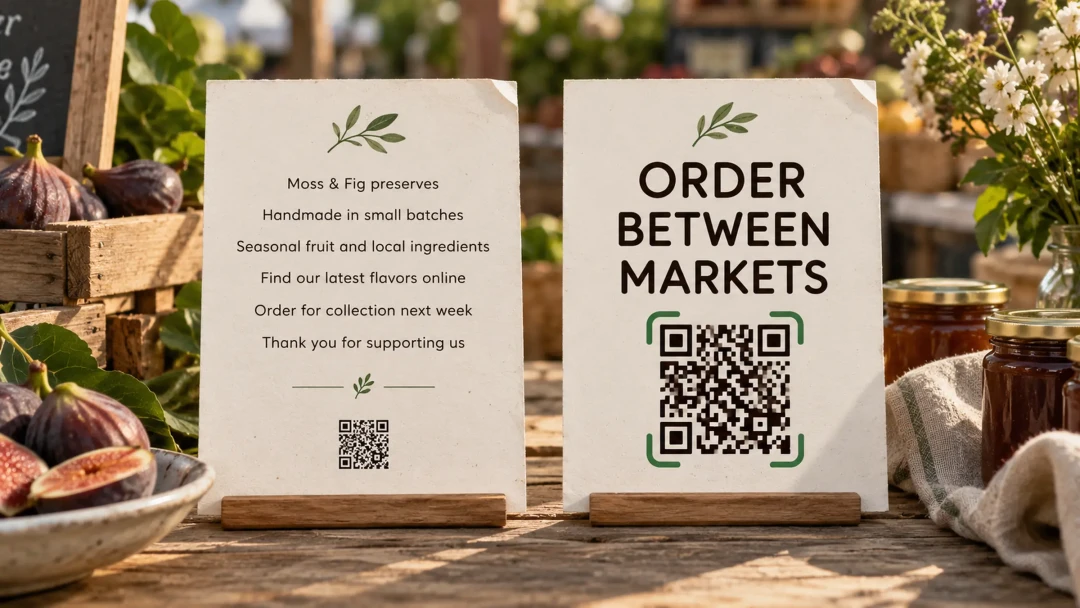
Why most QR codes at markets get ignored: because they say follow us. Nobody at a farmers market woke up wanting to follow anyone. A scan has to trade for something the person wants in the next ten seconds.
Same table, same light, same ten seconds. The one on the left asks you to read. The one on the right asks you to scan.
What to put on the sign
A reason, not a request. "Sold out? Reserve next week's here." "Get 10% off your first online order." "We ship — scan to see." Each of those is a reason. "Follow us on Instagram" is a request.
Big enough to read from behind someone else. Your table is often two deep. If the code only works when they're at the front, half the people who'd scan it never see it.
The written link underneath the code. Some people won't scan a code from a stranger. Give them the address to type.
One code, one job. Don't put four codes on the table. One.
Where to put it
On a stiff sign at eye level, not flat on the tablecloth where it's hidden by product.
On the card you hand with the bag — the moment they've already decided they like you is the best moment to ask for anything.
On the product itself, if it has a label. That code keeps working in someone's kitchen for weeks.
On the tent banner. People photograph tent banners.
Making the code, and printing the sign
The code itself: whichever platform you picked will generate one. If it doesn't, any free generator works — but use one that makes a static code rather than a tracking redirect. Free tracking codes get switched off or start charging, and then the sign in your van points at nothing. Test the printed code with your own phone before you print forty of them.
Printing: a home inkjet on cardstock is genuinely fine for table cards and product labels. For the tabletop sign and the A-frame, a local print shop or an online printer does a better job for a few dollars — and stiffness matters more than print quality, because a sign that falls over at 9am is a sign nobody scanned.
Size: the code wants to be at least an inch and a quarter across on the table sign, bigger on the A-frame. Smaller than that and it fails in direct sun, which is the exact condition it has to work in.
The one thing to say out loud
When you hand over the bag — "There's a code on the card, that's where you order between markets." One sentence. It roughly doubles what the sign does on its own, because now it's a person asking, not a piece of cardboard.
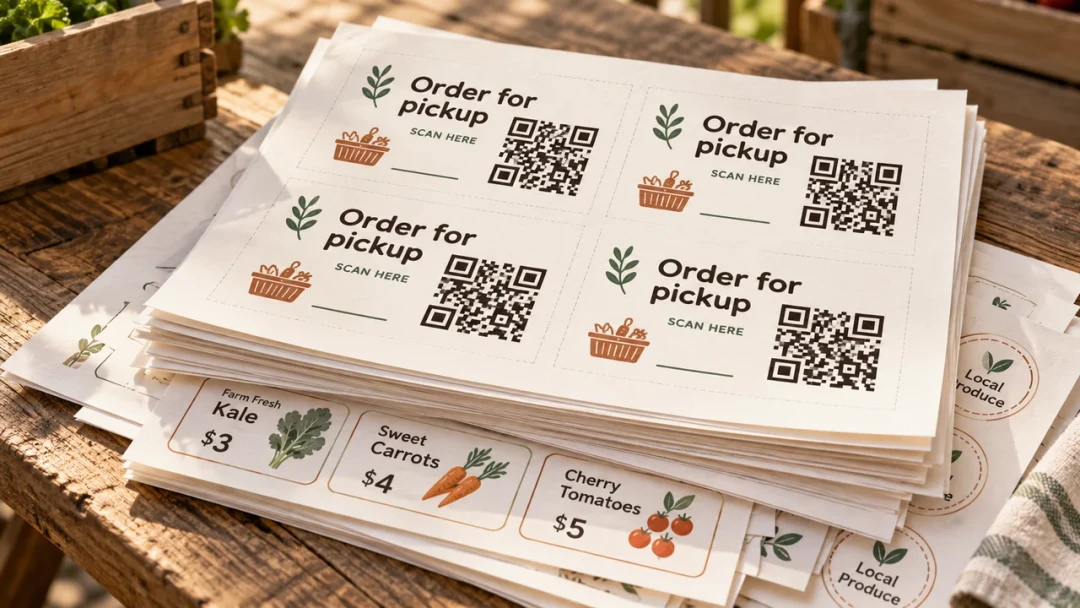
Ten-minute version: print one sign that says Sold out? Order for next week → with the code and the typed link. Prop it where people queue.
If you'd rather not design it
The signs on this list are already laid out and print-ready — two tabletop sizes, an A-frame, table cards, product labels, the tally sheet and the checklist as a poster, with real working codes. In the room. And the Brand Board Builder, which puts your own colours on all of it, is free and always will be.
3
The Sold-Out Ask
What it is: the thirty seconds after you tell someone you don't have what they want.
Why it's the most valuable moment of your day: that person is pre-sold. They've already decided. They want to hand you money and you're the one saying no. There is no warmer prospect at any point in your week. The only thing missing is somewhere to send them.
The script
Adapt the words, keep the shape:
"I'm out of those — they went early today. Two things I can do: I can put one aside for next Saturday, or I can ship you some this week. Scan this and it takes ten seconds either way."
Three things happen in that sentence. You replaced no with two yeses. You told them it sold out early, which is honest and also tells them to come earlier next time. And you gave them one specific action instead of a vague invitation.
Say it every time. Not just when you're fully sold out — every time anyone asks for something you can't hand them right now. Different flavour, bigger size, doesn't ship, out of cash.
For the people who aren't buying at all
Plenty of people taste, smile and drift off, and you already know better than to chase them. There's one low-pressure line that still works as they turn:
"If you want the recipe I use for these, it's on the card — same place you can order."
Now the person who wasn't going to buy anything is on your list. That's Part 4.
Ten-minute version: write the sold-out line on an index card and tape it inside your cash box where only you can see it. You'll use it by the third market without looking.
There is nothing that could be sold to you here. The Sold-Out Ask needs no tools, no design, and no setup — just the sentence, said out loud, every time. It's the highest-return thing in this entire playbook and it costs nothing. If you only ever do one part of this, do this one.
4
The List
What it is: the email addresses of people who like your product, kept somewhere you own.
Why this is the only asset that survives a bad season: your table depends on weather, the market's schedule, a permit, a parking spot, and whether the organizer renews you. Your Instagram following depends on a company that can change its rules on a Tuesday. Your list depends on nothing. It is the only part of your business you actually own, and it's the reason a rained-out Saturday doesn't have to be a lost Saturday.
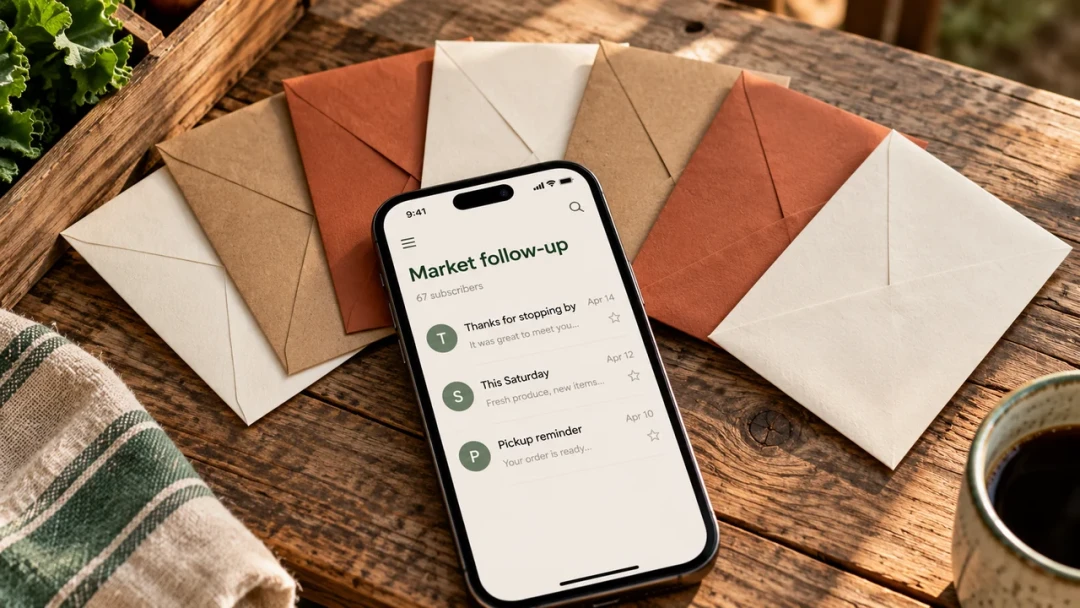
Sixty-seven addresses is not a small list. It is sixty-seven people who already said yes once, and it does not care what the weather does on Saturday.
Where the addresses come from
The scan does it for you. The best signup is the one attached to getting something — the pre-order, the discount, the recipe, the restock alert.
A clipboard still works. Paper, a pen, one column for email, a header that says what they get. Old, unglamorous, effective. Type them in Sunday morning.
At checkout. "Want the receipt by email?" is the least awkward way anyone has ever asked for an email address.
Never buy a list, never add someone who didn't ask. It's illegal in most places and it poisons the whole thing.
What to actually sign up for
Kit — free to 10,000 subscribers. What I use. Built for exactly this: one list, tags for what people care about, and sequences that send without you.
MailerLite — free to 1,000 subscribers and 12,000 emails a month. The simplest of the three to learn if you have never sent a marketing email.
Mailchimp — free to 500 contacts. The most recognisable name and the one most people reach for; also the one that gets expensive soonest.
All three are free at the size you'll be for a long while. Pick one, make one signup form, point the code at it, and stop reading about email tools.
One thing not to do: don't keep the list in your phone contacts, a notes app, or a spreadsheet you send from. Not because it's untidy — because sending marketing email from a personal address gets you marked as spam, and once your own address is burned you can't undo it.
What to say when you ask
Be specific about what they get and how often. "About twice a month — what we're bringing, what's back in stock, and where to find us." Vague asks get refused. Specific ones don't.
One number to watch: how many new emails you collect per market. It's the one number that tells you whether the sign is doing its job — and if it's low, that's a sign or a placement problem, which is the cheapest thing on this list to change.
Ten-minute version: sign up for a free email tool, make one signup form, point the QR code at it. That's it. Write to them later.
5
The Follow-Up
What it is: three emails that turn a Saturday scan into a Tuesday order.
Why lists go cold: not because anyone forgot. Two hundred addresses sit there while Wednesday is a production day and Thursday is a delivery day, and six months on, writing to them feels like starting over. The fix is a date, not a decision: send the first email within 48 hours, always.
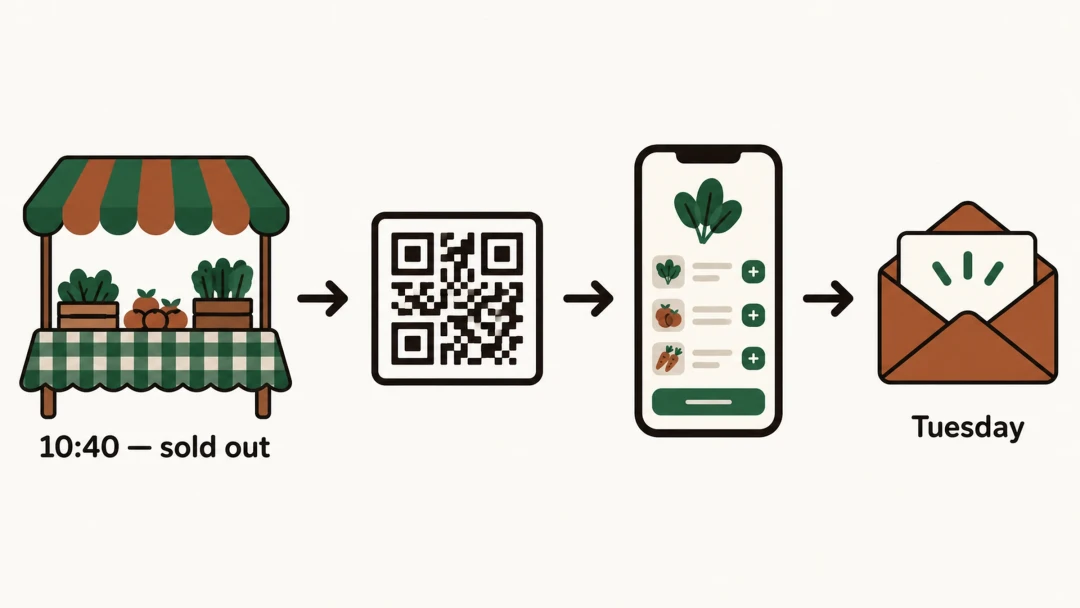
The whole system in four steps. Only the first one happens at the market — which is why the last one keeps working on a Tuesday.
Email 1 — Sunday or Monday. "Good to meet you."
Subject: Thanks for stopping by yesterday
Hi — I'm [name], you found us at [market] yesterday, the [what you sell] table near [landmark].
Thanks for stopping. Quick note on what happens next: I'll write about twice a month with what I'm bringing to market, what's back in stock, and where we'll be.
If you wanted something I'd run out of, it's here: [link]. I can put it aside for Saturday or ship it out this week.
See you soon, [name]
Email 2 — Wednesday or Thursday. "Here's what's coming Saturday."
This is the workhorse. It runs every week for the rest of your season and it's the one that actually produces orders.
Subject: What I'm bringing Saturday
Here's the list for [market], [time]:
• [item] — [one honest detail] • [item] — back after two weeks off • [item] — small batch, about [n] of them
The [item] has sold out before noon the last three weeks. If you want one held, reserve it here and it'll have your name on it: [link]
[name]
The reserve line is doing the work. It's true, it's useful, and it converts a "maybe I'll swing by" into a commitment.
Email 3 — 10 to 14 days in. "The one thing people ask me."
Give something away. Answer the question you get at the table every single week. Teach first, sell in one line at the bottom.
Subject: The thing everyone asks me at the table
Nine times out of ten, the question is [question].
[Two or three short paragraphs answering it properly, the way you'd say it standing there.]
That's it. If you want more of [product] before next market, it's here: [link]. Otherwise I'll see you Saturday.
Then keep going
Write like you talk at the table. That's the voice they signed up for.
Every email needs one link and one thing to do. Not five.
Nobody is annoyed by a short email from a person whose product they liked. They handed over the address on purpose.
Making the three emails send themselves
Every tool above calls it something different — Kit calls it a sequence, MailerLite an automation, Mailchimp a customer journey — and it is the same thing. Write the three emails once, set the gaps between them, and everyone who joins the list gets them in order from the day they join.
Set that up once and Email 1 goes out within 48 hours of every market for the rest of the season without you touching it. That is the whole reason this part works, and it is the step people skip — they write the three emails and then send them by hand, which lasts about three weeks.
Email 2 is the exception. It's different every week because what you're bringing is different every week, so that one you write and send yourself. Fifteen minutes on a Wednesday.
Ten-minute version: send Email 1 to everyone you've ever collected, today, even the ones from last year. One line saying you've been heads-down making things covers the gap. You'll get orders from it.
If you'd rather not write the other forty
The rest of the year is already written out — restock alerts, pre-order reminders, the abandoned pre-order chase, the holiday run, the off-season keep-warm and the win-back, plus a send calendar and sixty subject lines. In the room.
Print this
The Market Day Checklist
Tape it inside the van.
Printed at home the night before. The whole job is deciding to do it on Friday instead of Saturday morning.
The night before
Link works — open it on your phone and buy something as a test
Pre-orders for this market printed or on your phone
Sign packed, code tested with the camera
Cards in the bag, with the code on them
"What I'm bringing Saturday" email went out Wednesday
Setting up
Sign at eye level, visible from two rows back
Card stack where you bag things, not across the table
Tally paper and a pen in the cash box
All day
Say the line with every bag: "code on the card, that's where you order between markets"
Every no gets the Sold-Out Ask — pre-order or ship, so there is always something to hand them
One tally mark for every no
Every non-buyer gets the low-pressure line on their way out
Sunday morning, twenty minutes
Type in the clipboard emails
Send Email 1 to everyone new
Fill the pre-orders
Count the tally, write it down, compare to last week
You need three things, and there are free versions of all of them. Pick one from each row and stop researching — the setup matters far more than the brand.
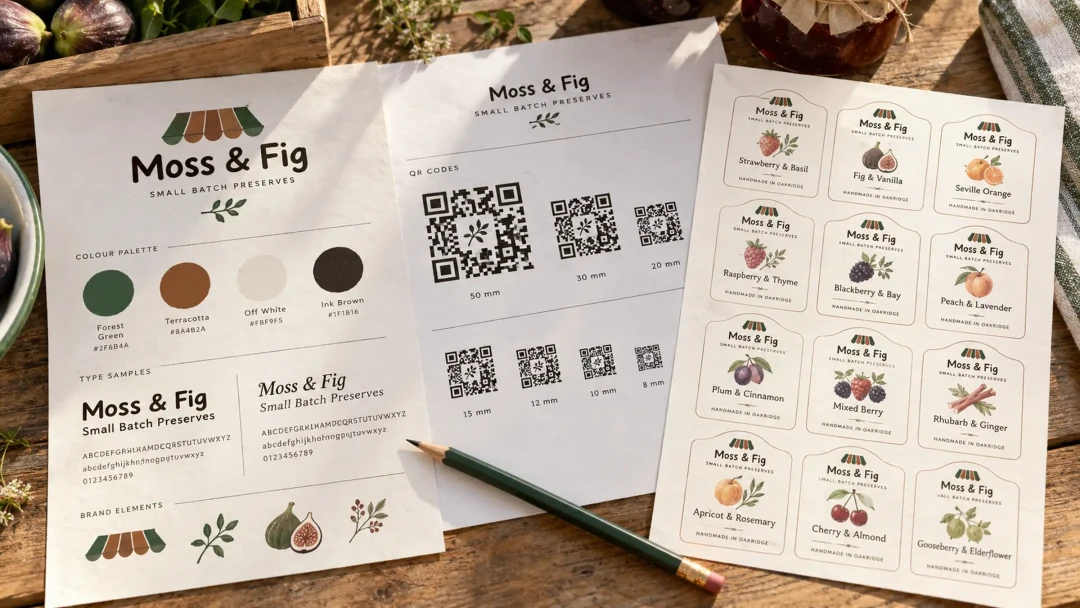
All three run in your browser, free, and hand off to each other — set your colours once and the other two open already wearing them.
A page that takes money
Your One Link. Pre-orders, shipping, gift cards, wholesale enquiries.
Shopify is what I'd pick · Squarespace Commerce · Square Online, free, if you already take cards with a Square reader
An email tool
Your List and your Follow-Up. Free at the sizes you'll be at for a long while.
Kit is what I use · MailerLite · Mailchimp — all three free to start
A card reader
Taking money at the table, and it should feed the same customer records.
Square · SumUp · Stripe Tap to Pay, which needs no hardware at all
The one rule that matters here: your card reader and your online shop should share a single customer list. That's why Square-with-Square, or Shopify-with-Shopify, beats mixing two companies — otherwise the person who bought from you at the table never appears on the list you email.
Straight talk: none of the tools named on this page are affiliate links — I don't get paid if you sign up for any of them. Some links inside the paid room are, and they're marked there. I only list things I actually set up for clients, and if you'd rather use something else, every part of this playbook still works.
At your number the constraint isn't knowing what to do, it's the evening it takes. So: you fill in
one form, I build the page, connect the payments, design the sign, set up the list and write the
three emails in your voice, and we get on a call so you can run it yourself.
Live before your next market.
Already sell through Shopify, Etsy or Square? Then we use
it rather than replacing something that works. The build is the missing pieces — the pre-order
path, the sold-out capture, the sign and the emails — onto whatever you already have.
One flat fee, nothing monthly. I take a handful at a time.
Where the rest of it lives
Market Ready — $9 a month.
Everything above is the instructions. The room is where the finished versions live — starting with
this playbook as a course, with the Market Day Checklist and the
three follow-up emails written out so you copy them instead of writing them.
Show me your table — post a photo of your stall, your sign
or your last email, and I'll tell you what's missing between it and the link.
Saturday numbers — two numbers after each market, which is
how we work out what's really converting rather than what sounds right.
And What's Working Now, rewritten monthly from those numbers.
What $9 is not: it isn't the whole library. The print packs, the
email vault and the funnel kit are bought separately in there, at member prices. The membership is
the door, not the shelf — and anything you buy stays yours whether you keep subscribing or not.
This page, the checklist and the three tools stay free forever, and you do not need to join to use them —
if you haven't done Parts 2 and 3 yet, do those first and come back. Having it built for you is the last
step, never the first: it's worth knowing what good looks like before you let anyone build it, which is
the whole reason this page gives the method away rather than selling it to you.